

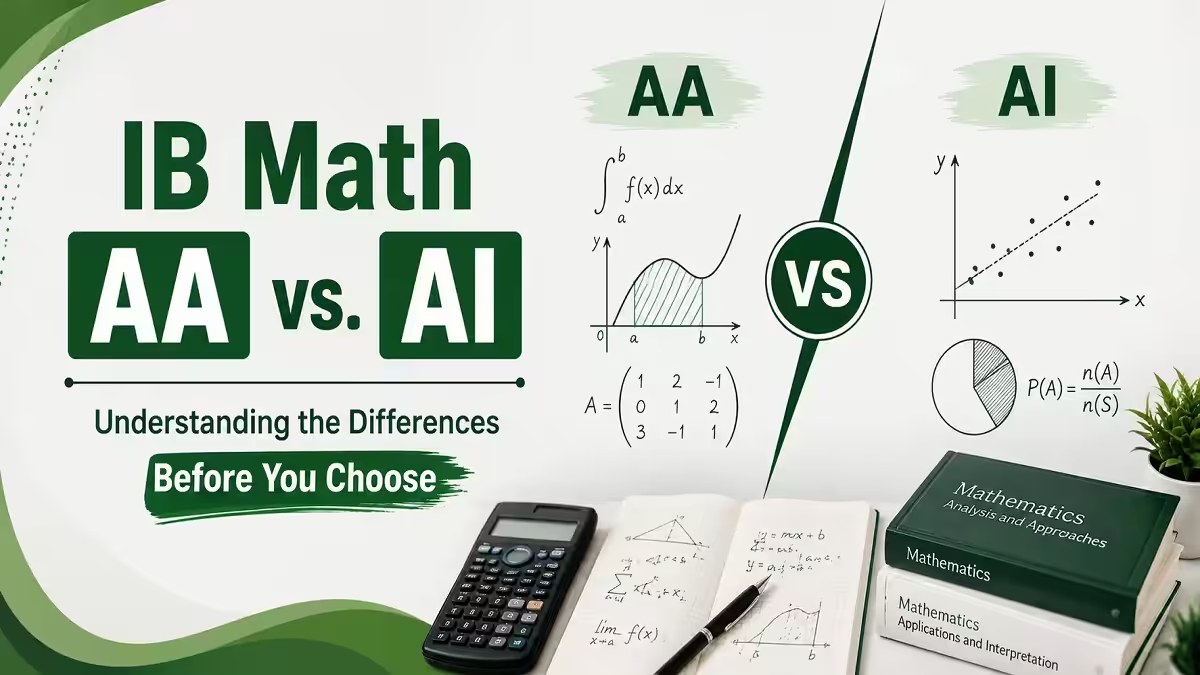
IB Math AA focuses on abstract math and concepts like calculus, while IB Math AI focuses on math, statistics, and technology in real life. Experienced IB writers suggest assessing mathematical abilities and university dreams before choosing whether to study AA or AI, because this choice shapes the career path that will be pursued a year later. Remember, these two are courses within the IB Math curriculum.
Each course has been designed for a different type of learning and understanding.
So, what’s your view? Which one’s for you?
Read on until the end of this write-up to discover soon and figure out how they operate as courses.
Why the IB Offers Two Mathematics Pathways
Each student has their own reason for studying mathematics.
Someone planning to pursue engineering may need advanced algebra and calculus, while another student interested in economics or psychology may benefit more from interpreting data and applying mathematical concepts to real situations.
The International Baccalaureate introduced two pathways so students could develop mathematical skills that better match their strengths and plans.
That distinction often helps students stay engaged because the course content feels more relevant to their interests.
Although both IB Math AA and AI require students to complete an IB mathematics internal assessment, the skills and approaches expected in each course can be very different.
What Is IB Math AA?
IB Mathematics: Analysis and Approaches (AA) places emphasis on mathematical reasoning and theoretical understanding.
Students spend most of their time learning how mathematical concepts work before applying them to increasingly challenging problems.
The topics include:
- algebra and functions
- trigonometry
- calculus
- mathematical proofs
- advanced problem-solving techniques
Lessons often require students to explain why a solution works instead of simply arriving at the correct answer.
Abstract thinking becomes important as the course progresses.
Students who enjoy recognizing patterns and like to work through detailed calculations often find this pathway rewarding.
But if your confusion still exists after making the choice, professional IB writers can help you understand assessment expectations while developing stronger analytical and problem-solving skills.
What Is IB Math AI?
IB Mathematics: Applications and Interpretation (AI) approaches mathematics from a different perspective.
It focuses on applying mathematical ideas to practical situations instead of keeping its primary focus on theoretical concepts.
Students regularly work with:
- statistics
- probability
- modelling
- data interpretation
- technology-based problem solving
Graphing calculators and digital tools become an important part of classroom learning because they reflect how mathematics is used in many professions.
You will find students asking, “What does this information tell us?” or “How can mathematics help explain this real-world situation?”
Quick Overview Of IB Math AA
- Students spend more time developing mathematical theory and solving complex algebraic problems.
- The lessons focus on logical reasoning and detailed mathematical working.
- This course suits students who enjoy abstract thinking and theoretical mathematics.
Quick Overview Of IB Math AI
- Students focus on applying mathematics for interpreting data and solving real-world problems using mathematical models.
- Lessons often involve technology, financial mathematics, and interpreting information presented in graphs or datasets.
- The course appeals to students who prefer seeing mathematics applied to everyday situations and future careers.
What learning style will you prefer more?
It would be a good approach to compare the courses by asking yourself what kind of math you enjoy doing. The consultations provided by IB writers are what they say below. AA will be more suitable for you if you enjoy working with complex algebra and multiple steps to reach a solution.
AI will be a better fit if you prefer math that focuses on trends and decision-making. What has been stated above does not determine students based on their mathematical skills but rather on how they learn math.
University Plans Should Influence Your Decision
You should always look beyond the next two years before choosing either course.
Many universities publish mathematics requirements for specific degree programmes.
- Courses such as engineering and some computer science degrees often expect applicants to have studied IB Math AA, particularly at Higher Level.
- Other subjects such as business and many social science programmes frequently consider IB Math AI an appropriate qualification, depending on the university and country.
You should always check the entry requirements for a few universities that interest you instead of relying on assumptions. This is because a small amount of research now can prevent disappointment later.
Don’t Just Choose Based on Difficulty
Both pathways are academically demanding, but they challenge students in different ways.
AA often requires confidence with algebra and abstract reasoning, whereas AI focuses on selecting appropriate mathematical methods and applying technology effectively.
Choosing a course simply because someone described it as easier can make studying more difficult if the teaching style doesn’t suit the way you learn.
A better question is:
“Which course matches the way I naturally think?”
Speaking with Teachers Can Make the Decision Easier
You should ask for advice from the teachers who already know your strengths if you’re still uncertain.
They have seen how you approach problem-solving, whether you enjoy theoretical work or practical applications, and which topics you handle most confidently.
Their recommendation comes from your classroom performance rather than assumptions about future careers.
You can also speak with older IB students who have completed each course. Their experiences may help you understand the assessment style and pace of learning in a more realistic way.
FAQs
- Are students allowed to change from IB Math AI to AA during the course?
This may be possible, depending on school policy and the stage of the academic year, but switching late into the year is not easy since the courses will have developed different skills by then.
- Is the Internal Assessment part of both IB mathematics courses?
Yes. Both pathways have the Internal Assessment that enables the student to explore a mathematical topic independently and show what he/she has learned through the process in a written assignment.
- Is there a graphing calculator in both courses?
Yes. While the technology is used extensively in both paths, it plays a very important role in IB Math AI since the student uses it regularly to analyze and interpret data mathematically.
Wrapping Up
The main difference between IB Math AA and IB Math AI is in how each teaches students to become good mathematicians. IB AA program gives preference to theories and analysis, whereas IB AI emphasis on real-life practice and understanding of information received.
Choosing the right track depends on individual preferences and future goals. Considering all these factors while having the support of IB writers by your side will make the Diploma Program more interesting and will prepare you for what awaits after graduation.